A simple system for using caffeine as an amplifier—not a baseline
Most people don’t realize they’re dependent on caffeine. Around 80–90% of adults in the U.S. consume caffeine every day. It works—it gives you energy, focus, and helps you get through your day. But over time, it quietly shifts from something you use into something you need just to feel normal.
I didn’t fully realize this until I tried going without it. What I discovered wasn’t that caffeine was “bad.” It was that I had lost my sensitivity to it—and with it, my ability to feel my natural energy clearly.
In a world where we’re constantly stimulated—by screens, notifications, and endless inputs—caffeine just adds another layer. What I was really looking for wasn’t more stimulation. It was a way to reset.
That’s what led me to experiment with what I now think of as caffeine fasting.
The short version
If you only remember one thing, it’s this: don’t use caffeine every day. Give your body regular breaks so it can reset—everything else builds on that.
From Fasting to Using
My first instinct was to quit caffeine completely. I even did a three-month stretch without it (I wrote about that experience here), which helped break the cycle of daily dependence—afternoon crashes, poor sleep, and the withdrawal headaches that came when I stopped.
But over time, I realized something important. Caffeine itself wasn’t the problem. How I was using it was.
So instead of avoiding it entirely, I shifted to something more flexible: regular periods without caffeine, combined with intentional use on specific days. Not abstinence, but a rhythm of reset and use.
The Real Model: Nervous System Balance
What changed everything for me was seeing caffeine through a different lens.
- Caffeine stimulates your body’s “go” mode (like a gas pedal)
- Your body also has a “rest” mode (like a brake)
Instead of asking whether I should have caffeine, I started asking what state my body was already in. If I was stressed, low energy, or already wired, caffeine pushed me further out of balance. If I was well-rested, it felt clean, useful, and even enjoyable.
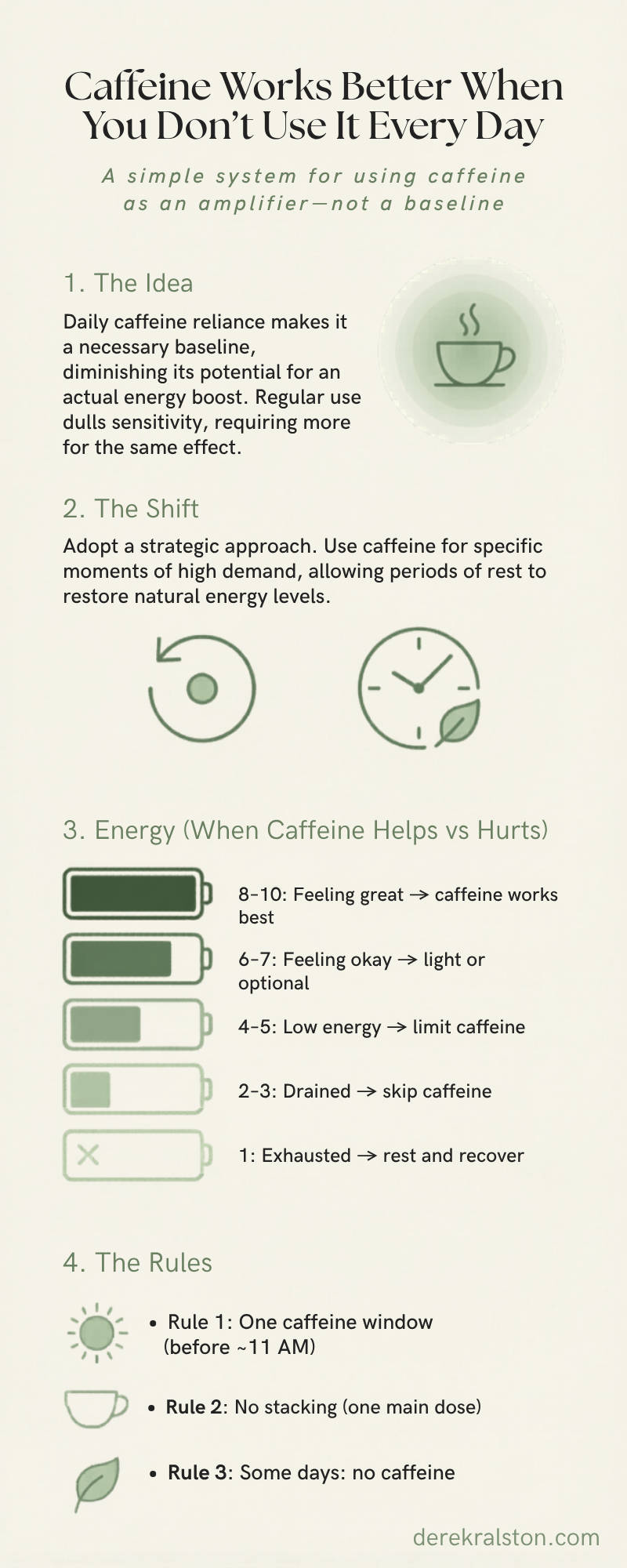
Energy (When Caffeine Helps vs Hurts)
Before reaching for caffeine, do a quick check-in:
How do I feel right now? (1–10)
8–10 (Good / Energized) Caffeine tends to work best here. It can take a good state and amplify it.
5–7 (Okay / Neutral) You can go either way. A small amount might help, but it’s not going to change your day.
1–4 (Drained / Depleted) This is where it gets counterintuitive. This is when most people reach for caffeine — and when it tends to work worst. Instead of restoring energy, it often just makes things feel more wired and less stable, and can make sleep worse later.
A better way to think about it
Caffeine isn’t really a fix for low energy — it’s more like an amplifier.
What I’ve found is that it works best when my body already has the capacity for stimulation. If I feel good, it enhances that. If I feel depleted, it usually just adds noise on top of it.
Most people are operating a little depleted by default, which is part of why caffeine becomes a daily habit. This approach flips that.
What to do instead on low-energy days
On low-energy days, the goal isn’t to push through with caffeine. It’s to actually restore your baseline.
That usually looks like:
- eating something simple (carbs + protein)
- drinking water (maybe with a pinch of salt)
- taking a short walk
Not exciting, but it works much better than trying to override how you feel.
The Two Rules That Matter Most
After a lot of experimentation, most of the benefit came down to timing and avoiding stacking.
Timing matters more than I expected. I now keep all caffeine before about 11 AM. With a half-life of roughly five hours, 100 mg at 11 AM still leaves about 25 mg in your system around 9–10 PM—enough to subtly impact sleep. Thinking in terms of what remains at night changed how I use caffeine more than anything else.
Stacking was the other issue. My pattern used to look like this: tea, then matcha, then a milk tea—multiple small doses that didn’t feel like much individually but added up over time. The result was a longer caffeine curve, more impact on sleep, and a stronger sense of dependence. The fix was simple: one main caffeine moment per day, most of the time.
Why Caffeine Fasting Matters
One of the biggest insights for me was that if you never fully clear caffeine, you’re never truly at baseline. Because of its half-life, if you’re using it every day, you may not fully clear it before your next dose.
Regular no-caffeine days:
- reset tolerance
- restore sensitivity
- improve sleep
They’re not about restriction—they’re what make caffeine work again.
Matching Caffeine to the Day
Instead of using caffeine every day, I started matching it to when it was actually worth it.
- Strength training → improves performance and enjoyment
- Hikes or social experiences → enhances the moment
- Already tired or stressed → usually makes things worse
Caffeine works best when it amplifies good states, not when it tries to compensate for bad ones.
A Weekly Rhythm (Optional Structure)
Alongside this, I keep a loose weekly rhythm—not as a strict rule, but as a backdrop.
- Mon / Wed / Fri → no caffeine (reset days)
- Tue / Thu → light caffeine (strength training)
- Sat → flexible (often a hike with my wife Joanna)
- Sun → flexible (another workout or active day)
The difference now is that this rhythm is secondary. How I actually feel takes priority. If I feel low energy, I skip caffeine—even on a “flexible” day. If I feel good, I might use it on a weekday.
The rhythm provides structure, but it doesn’t override what my body is telling me.
Travel / Vacation
When I’m traveling, I relax the system. I still keep the most important rule—caffeine early in the day—but everything else becomes more flexible. I might have fewer no-caffeine days, and there’s more room for rituals like tea or coffee.
The goal isn’t perfection. It’s to enjoy the experience without losing the structure that protects my sleep.
What This Feels Like
The biggest shift hasn’t been physical—it’s been mental. I used to feel dependent and reactive, like I needed caffeine just to function. Now it feels optional and intentional, aligned with how I actually feel.
Some days I use it and enjoy it. Some days I don’t think about it at all.
Takeaway
Around 80–90% of people use caffeine every day, often without questioning it. I was the same way.
What changed for me was simple: I stopped using it daily and started using it intentionally—early, without stacking, and only when it actually added value.
Now it’s something I choose, not something I rely on. And when I do use it, it actually works.
Most days, I don’t think about caffeine at all.


Leave a Reply