Derek Ralston

personal transformation through self-experimentation

  • Blog
  • Resources
  • Books
  • About
  • Contact
  • Transformational Fasting

I Stopped Drinking for Three Months, Here’s What Happened

May 6, 2019 by derek Leave a Comment

I Stopped Drinking for Three Months, Here’s What Happened

Being a data nerd sometimes leads me to change my habits in significant ways. One day, I was glancing at my data-driven diary, and noticed I was drinking a beer or two with dinner, which seemed innocent enough. The problem was that this had been going on for 20 days straight. Whether I was out with friends or at home alone, I was using alcohol to relax in the evening and deal with the discomforts of life.

I didn’t feel the need to stop drinking forever, but I was curious about experimenting with a break from drinking. I started a no drinking experiment in order to:

  1. Find better ways to cope with stress and uncomfortable social situations
  2. Seek more restful sleep
  3. Reconnect with myself and sit with the discomfort that I had been using alcohol to mask (sort of like a fast)

What Happened: The First Two Weeks

My sleep was noticeably improved. I could sleep longer, didn’t wake up as much in the middle of the night, and woke up well-rested. I had vivid dreams as my REM sleep reset to normal levels (some of these dreams were quite disturbing but things settled down after the first few days).

I felt more stress at work (and stronger emotions in general), which led to me choosing to spend more time doing yoga and meditation as a transition into my evening activities. I also noticed that the normal level of caffeine I was drinking (two cups of coffee, one tea) was suddenly too much for me, exacerbating work stress, so I decreased to one cup of coffee. Things felt overwhelming for a few days, but I slowly adjusted to it. I became noticeably hungrier, and had cravings for sugar. I imagine these sugar cravings were partially what I had been filling with alcohol in the past. Instead, I made myself healthy desserts like berries and cream.

I felt myself digging deeper for meaning in my day-to-day interactions, spending more time in a mindful state and less in autopilot. This was both at work and in the evenings and weekends. I started noticing times in the day where my energy felt strong, and other times when it was depleted, and the causal relationship behind this. I spent more time alone, checked my phone less, and spent more time doing what makes me happy in my free time.

What Happened: Sober Firsts

The Company Party

By default, I would drink at company parties. This started when I worked in consulting, where drinking was a big part of the company culture. The sensory overload of being around all my coworkers and making small talk all night felt draining as an introvert, and alcohol played an important role in helping me relax. Or so I thought. This company party, I arrived in my best cocktail attire, and drank lime and sodas all night.

It was interesting noticing my impulse to take a sip of my lime and soda, as if it would put me at ease. Instead of trying to make small talk, I had several deep conversations with coworkers I wanted to catch up with. And I enjoyed the music, and even danced a little. It was refreshing, and a better experience than I remember having at past company events where I would drink my discomfort away.

And the best part? I woke up the next morning feeling great, which was convenient as I had been tasked with facilitating a group discussion.

The First Date

Before this experiment, I would often have a first date at a wine or cocktail bar. It was an easy way to loosen up and get to know the other person. Since my no drinking experiment, I let my potential dates know I was not drinking, and have gotten mostly positive feedback. The few times I got a negative response, I considered it a sign that the person wasn’t a good match for me, or that they potentially had a drinking problem.

If we met for dinner, I wanted my date to feel comfortable, so I would let her know that I was fine with her having a drink. Sometimes, she would have one, other times, we’d both be sober. While I initially had fears around what my date would think if I didn’t drink, I found that these were unfounded. As long as we were having a good time together and getting to know each other better, that’s ultimately what mattered.

What Happened: Three Months Later

I started this experiment thinking I’d stick to not drinking for a month. It has been three months now, and the lines are beginning to blur between “experiment” and “lifestyle choice.” I still have beer in my fridge and wine in my cabinet. It’s waiting there if I want it. But right now, I don’t.

The biggest shift I’ve noticed is that I deal with problems that arise in my life in a healthier way:

  • Getting out of my head and into my body: Before, I might come home from work, make dinner, and watch Netflix with a beer. Now, I get home, get changed, and go to yoga. In general, I’m more active, whether that be cycling, hiking, yoga, or exploring the city by foot. I choose something that gets me out of my head and into my body.
  • Trying natural supplements for stress: I’ve been experimenting with 100mg of rhodiola in the morning. This seems to give me energy and reduces stress. I also often pair my morning coffee with l-theanine, which produces a calming energy similar to what you get when you drink green tea or matcha. And with dinner, I’ll take magnesium, which is a natural relaxer.
  • Taking responsibility for my circumstances: Instead of masking problems in my life by dulling my senses with a drink, I try to get to the root cause of them. This might mean saying “no” to more things at work or in my social life, to truly appreciate the things I say “yes” to.

Further Reading

To prepare for my no drinking experiment, I read Sober Curious by Ruby Warrington. Warrington’s book is both entertaining and informative. She dispels myths about non-drinking being no fun (she calls this FOMA: Fear of Missing Alcohol), while offering ideas on living an amazing life without alcohol.

Here are some of my favorite passages from it:

On being present

The alcohol problem I have since identified in myself was that booze was preventing me from being fully present in my life. By which I mean, it was preventing me from knowing, in each and every moment of each and every day, what it really felt like to be ME—a “problem,” since it’s only from this place of knowing, of presence, that I can truly choose which decisions to make and which next actions to take in service of my own highest good—in order to create a life that feels meaningful to me.

On drinking consciously, and asking yourself why you choose to drink

The farther I leaned into my Sober Curiosity, each time I drank became a mindful and fully conscious choice—one I often entered into as an experiment of sorts. An experiment designed to answer yet more questions: How will this drink make me feel? Will it enhance the situation or detract from it? What are all the reasons—emotional, social, physical—I’m choosing to drink?

As you begin experimenting with longer and longer periods of abstinence, try to develop an interest in the specific situations where FOMA (Fear of Missing Alcohol) kicks in for you. On the other side of the knee-jerk response to reach for a drink, this is valuable insight into all the reasons you use booze: aka Sober Curious gold.

Getting comfortable with discomfort

Sitting in the WTF, watching it pass, and then choosing to focus on the positive parts of the experience is the physical part (and the mental workout) of your beginning to create new neural pathways. And this is really how you change your drinking habits. I call it “getting comfortable with being uncomfortable”—a life hack that can benefit you in so, so many ways.

If you hate your job, the “escape” of Friday night drinks means you have to endure only five days of misery at a time. You’ll quit that job and do something more interesting with your life way faster if there’s no get-out-of-jail-free card waiting at the end of the week.

Sobriety and relationships

“When sobriety enters a relationship and that artificial lubrication is gone, rough spots become more apparent. It’s harder to hide. Many people find they are not as compatible or attracted or tolerant.” But on the flip side, “if the sobriety is approached in a conscious way,” Wagner maintains, “a whole new level of intimacy can be opened. Hearts are uncovered. Revelations and ‘deep insights’ are legitimate and longer lasting.” Yes, friends, just when this whole “sober relationships” thing was beginning to look like it might be all uphill, I bring you hope. Which doesn’t mean it won’t also take plenty of work—not least on your relationship with number one (yes, YOU).

Getting high off your own supply

The irrepressible feelings of joy behind this kidlike behavior, which would also sometimes spill out as fits of uncontrollable laughter, usually kicked in only after at least three weeks of being booze-free—as if that’s how long it took for the dregs of my last “drunk” to completely leave my system.

“In many shamanic societies, if you came to a shaman or medicine person complaining of being disheartened, dispirited, or depressed, they would ask you one of four questions: When did you stop dancing? When did you stop singing? When did you stop being enchanted by stories? When did you stop finding comfort in the sweet territory of silence?” Arrien calls these the “four universal healing salves.”

“When [a person has] organized their life around a substance in such a way that the only time they have fun is when they’re engaged with that substance . . . when the substance goes away, at first one might think, ‘Oh my god. The party’s over.’ But the party’s not over at all. The party’s just beginning, but in a different way than what you’re used to.”

Key Takeaways

  • Doing your own no drinking experiment can lead to:
    • Noticeably improved sleep
    • Learning new ways to cope with stress (e.g. yoga, meditation)
    • Digging deeper for meaning in your day-to-day interactions and relationships
  • My big takeaways after three months of no drinking:
    • I spend my time in the evenings a lot differently: Since I stopped drinking, I spend a lot more time doing yoga and meditation. More reading. Less Netflixing.
    • I found natural supplements to help me deal with the stresses of life in a healthy way: I use rhodiola, l-theanine, and magnesium, as ways to reduce my stress and give me a healthy source of energy (along with a healthy diet of whole foods).
    • I learned to take responsibility for my circumstances: I started getting to the root cause of my problems, versus dulling my senses to deal with the realities of life.


Photo by mnm.all on Unsplash

Share this:

  • Tweet
  • Email a link to a friend (Opens in new window) Email

Effectively Dealing with Writing Procrastination

December 17, 2018 by derek Leave a Comment

Effectively Dealing with Writing Procrastination

Novelist Sidonie-Gabrielle Colette plucked fleas from her bulldog, Souci, as a procrastination habit. She’d pluck them one by one, switch to other forms of procrastination, and finally sit down to write.

When you procrastinate, you probably don’t pick fleas from your dog’s back. More likely, you check your email, clean your house, or water your plants.

What’s the most effective way to deal with writing procrastination? It  depends on the flavor of procrastination you’re experiencing. Maybe you could be diligently writing each day. On the other hand, maybe your subconscious is at work and you just need a few days away from the piece.

Let’s talk about how to deal with each variety of procrastination.

Productive procrastination

You wrote a first draft and tried editing it but didn’t make progress. Your subconscious needs a few days to process what you wrote.

Here’s how to deal with productive procrastination.

Write something else

Productive procrastination doesn’t mean you replace your writing time with getting to level nine of Candy Crush Saga. You still have self-discipline and write when you normally would, you just don’t force yourself to work on that piece.

If you are purposefully procrastinating, how do you spend your writing time?

  1. Switch it up: For example, draft a different chapter of the book you’re working on.
  2. Go freestyle: Try freeform train-of-thought technique by writing what comes to my mind (without hitting backspace or delete).

Bake procrastination into your writing deadlines

Pad extra time into your writing deadlines. Jerry Jenkins finds this useful for his book deadlines:

When I’m scoping out my writing calendar for a new book, I decide on the number of pages I must finish each writing day to make my deadline. Then I actually schedule Procrastination days.
-Jerry Jenkins

There is one caveat to this strategy: Jenkins never lets his procrastination get out of hand. He keeps his deadline sacred, so the number of pages he has to write per day is always within his capacity.

Plan for procrastination while keeping your writing deadline sacred. Share on X

Now let’s talk about when the act of writing feels uncomfortable.

Discomfort procrastination

When you sit down to write, it feels uncomfortable. Someone deep inside you is screaming I don’t wanna do this, can we go watch Youtube instead?

Discomfort is normal when writing isn’t part of your routine. When speaking of his morning routine when writing a novel, Haruki Murakami said, “It’s just a routine. It’s kind of boring. It’s a routine. But the routine is so important.”

You feel more emotional about writing when you do it less. Studies show that tasks becomes less emotional the more often you do them. When your writing becomes less emotional, that’s a good sign you’re on your way to developing a habit. (Stephen Guise wrote an excellent blog post about this.)

Here’s how to deal with discomfort procrastination.

Figure out why you aren’t writing

Get out your journal. Ask yourself Why am I choosing not to write? Then ask why five more times. This is called the 5 Why’s Technique, see examples of it in Get Energized to Write.

Drilling into your why for not writing, your emotions are revealing. Fear is a sign that you need to push forward:

Are you paralyzed with fear? That’s a good sign. Fear is good. Like self-doubt, fear is an indicator. Fear tells us what we have to do. Remember one rule of thumb: the more scared we are of a work or calling, the more sure we can be that we have to do it.
-Steven Pressfield, The Art of War

Lower your writing benchmark

You’re setting the bar too high for yourself, your first draft is going to suck, and that’s okay. Set your writing benchmark lower to find your personal writing sweet spot.

It’s counterintuitive, but setting your writing goal ridiculously low will lead to more writing output. I have a goal to write 50 words each day. That low bar leads me to action, and I usually surpass it by 10-20x. I use a Don’t Break the Chain calendar printable to keep myself accountable.

Just write something

If you don’t know what to write about, or you are in between writing projects, try to sit down and write something. Try freeform train-of-thought writing by putting on your creator hat and writing what comes to mind. Don’t hit backspace or delete. Or use a writing prompt to give yourself focus.

Fear is a sign that you need to push forward. Try to sit down and write something. Share on X

Key Takeaways

  • Productive procrastination is when your subconscious needs a few days to process your work
    • Step away from the piece you are procrastinating on, not your writing routine
    • Bake procrastination into your writing project deadlines
  • Discomfort procrastination is when the act of writing feels uncomfortable
    • Discomfort is normal when writing isn’t part of your routine
    • Figure out why you aren’t writing
    • It’s counterintuitive, but setting your writing goal ridiculously low will lead to more writing output
    • Focus on sitting down and writing something

(photo by rawpixel)

Please subscribe to the newsletter below for more writing productivity tips.

Share this:

  • Tweet
  • Email a link to a friend (Opens in new window) Email

Overcome Writer’s Block Using the Two Writing Hats Technique

December 3, 2018 by derek Leave a Comment

Overcome Writer’s Block Using the Two Writing Hats Technique

Staring at a blank screen, you’re not sure what to write. On the edge of losing your mind, you’re like Jack Torrance in The Shining, filling pages with the proverb “All work and no play makes Jack a dull boy.”

You’re blocked but you don’t have to be. You can finish that blog post, turn in that essay, or ship that novel you’ve been working on from the snowy Overlook Hotel. I’ll show you how.

What is writer’s block?

Writer’s block is like a stomach ache: it’s a symptom. Was it the six cups of coffee, the barbecue, or the all-you-can-eat buffet? You need to figure this out.

What is causing your writer’s block?

  • You believe you’re not a good writer. Overcome the ‘I’m Not a Good Writer’ Belief and Self-Doubt.
  • Perfectionism has you stuck. Get Over Your Perfectionism and Write Something.
  • You’ve got a bad case of procrastination. Build a Writing Habit that Sticks.
  • You can’t focus. Use the Pomodoro Technique to Manage Your Writing Time.

Here’s a technique which helped me overcome writer’s block.

The Two Writing Hats Technique

Do you write a first draft and edit it at the same time? This is like switching between two tabs on your computer every few seconds. Creating and critiquing use different parts of your brain, which means writing and editing at the same time is a recipe for writer’s block.

You want to plan writing sessions intentionally so your only focus is writing your first draft, or editing it, never both. The Two Hats Writing Technique helps you do this.

Put on your Creator Hat when writing a first draft

When you wear your Creator Hat, you’re open to all possibilities and ideas. Words flow onto your page without judgement (even if they’re mispelllllllllleed).

You have ENDLESS POSSIBLIITIES with your writing. Write write write, new ideas flowwww…… Break rewl$. Who cares about pncutation? No backspeca alowed. Give me a FOCUS and I will writee write writee about it. It’s okay, I’m just your FIRST DRAFT.
-Your Creator Hat

Before putting on your Creator Hat, prepare a writing prompt at the very least, and better yet, an outline. Then just start writing. No backspacing or deleting allowed.

For first drafts, no backspacing or deleting is allowed. Share on X

Wear your Editor Hat when revising your draft

When you put on your Editor Hat, you become more critical and cautionary. This hat is best worn when you want to clean up your draft before publishing it.

I’m the sheriff in this town. You’d better check your facts on that research cited. And fix those spelling mistakes. I don’t think that last section flows very well, you’d better fix it. Have you tried reading the whole piece out loud? Have you printed it off and edited your words in print?
-Your Editor Hat

When editing, try to play devil’s advocate, move words around, remove clutter, and simplify.

Productive procrastination

For each piece you’re working on, create space between your creating and editing sessions. Don’t edit work that you drafted that same day. Give the piece time to sink in and you’ll be able to approach it with a fresh pair of eyes.

Letting your mind take a break allows your creative juices to flow. Share on X

When you let the first draft sit for a few days, your subconscious has a chance to come up with new approaches:

When you take a walk, go for a run, or pursue everyday activities that don’t require effortful focus, your mind can enter a state of open attention. During these periods, other parts of the brain can be heard above the stream of intentional thought. Ideas often appear out of nowhere, or we suddenly remember important, unfinished tasks we had forgotten.
-Anne Janzer, The Writer’s Process

Need more convincing?

Using the Two Hats Writing Technique, I unblocked myself and doubled my writing output. Yes, I spent more time editing my work, but it was worth it. And with practice I improved.

Key Takeaways

  • Writer’s block is like a stomach ache: it’s a symptom of something deeper you need to figure out.
  • Writing a first draft and editing it at the same time can lead to writer’s block, especially if you tend towards perfectionism.
  • The Two Hats Writing Technique: Plan your writing sessions intentionally so your only focus is the first draft, or editing it, never both.
    • Creator Hat: For writing a first draft. Open to all possibilities and ideas. No backspace or delete key allowed.
    • Editor Hat: For revising your draft into something you can publish. Judging, cautionary, and checking for mistakes. Play devil’s advocate, simplify, and declutter your writing.
  • After writing your first draft, procrastinate on editing for a few days. When you let your work sit, your subconscious has a chance to come up with new approaches.

Subscribe to the newsletter below so you don’t miss out on more writing productivity tips.

(photo by Steve Johnson)

Share this:

  • Tweet
  • Email a link to a friend (Opens in new window) Email

Get Energized to Write (Even When You’re Too Tired after Work)

November 19, 2018 by derek Leave a Comment

Get Energized to Write (Even When You’re Too Tired after Work)

William Burroughs was an exterminator. Harper Lee was a ticket agent. Jack Kerouac was a dishwasher. And Charles Bukowski? A mailman.

Coming home from work exhausted, you wonder, how did they make it work?

Professionals learn to manage their energy.

Find out where your energy is going so you can show up for your passion.

Figure out why you’re too tired to write

When your bank account is low, it’s easy to see why. Glance at your credit card bill for last month and you might find the Apple tore or a fancy Italian restaurant.

Your energy reserves run low in the same way.

Use the 5 Whys Technique

The 5 Whys Technique helps you explore the cause-and-effect relationship between your low energy and daily activities.

Here’s an example:

Problem: I’m too tired to write.

  1. Why? I didn’t get enough sleep. (First why)
  2. Why? I stayed up too late. (Second why)
  3. Why? I was busy on my laptop. (Third why)
  4. Why? I was watching Netflix. (Fourth why)
  5. Why? It’s a series I’m watching… I’m kind of hooked. (Fifth why, a root cause)

The questioning can be taken further, but five iterations is usually enough to find a root cause. The outcome of this example? The writer needs more sleep. They can try an evening shut down routine by shutting down all electronics and bright lights an hour before bedtime.

Another example:

Problem: I’m too tired to write.

  1. Why? My workday was exhausting. (First why)
  2. Why? I was in meetings all day. (Second why)
  3. Why? As an introvert, meetings tend to drain my energy. (Third why)
  4. Why? I get my energy from alone time. (Fourth why, a root cause)

In this case, the writer has too many meetings, and maybe they’re an introvert in an extrovert’s job. They need to either manage their energy or change their job (I wrote Escape the Rat Race to explore solutions to this problem).

After understanding why you’re too tired to write, you’re ready to explore solutions.

Optimize when you write

Sean McCabe was a night owl writer. He ran an experiment comparing his writing output at night versus day:

When I woke up early and started my day with writing the word count results were double that of my Night Owl output.
-Sean McCabe

McCabe then permanently switched his writing routine to the morning. Research confirms McCabe’s experiment. A two year study analyzed the mood of 500 million tweets (see the journal Science). The results show that our moods peak early in the morning, hit a low point in the afternoon, and rise again in the evening. (When by Daniel Pink explores this extensively.)

What does this mean for you? You likely have more energy in the morning. Try waking up earlier and writing before work.

Break up your day

All work and no play makes Jack a dull boy.
-The Shining

Schedule breaks throughout your day to replenish your energy. Put breaks on your calendar so you’re reminded to take them. Treat your breaks like important meetings you need to attend.

After an eight hour workday, you’ve depleted much of your willpower. Doing an unwind activity helps you recharge. Try having dinner, meditating, or exercising before writing.

If you plan to write after work, give yourself a chance to unwind first. Share on X

Buy back more time and energy by saying no

Say no more often to prioritize writing time.

Say no to taking on extra responsibilities at work not aligned with your growth.

Say no to social activities that feel more like obligations than meaningful connections.

Say no to intrusive app notifications on your phone.

Say no to starting a Netflix series you know you’ll get sucked into.

Who you are, what you think, feel, and do, what you love—is the sum of what you focus on. - Cal Newport Share on X

Seven more tips for when you’re too tired to write

  1. Start small: Instead of a large goal like 1000 words per day, try 50 words per day.
  2. Try writing when you’re tired: As your inhibitions are lower, you become more creative, like writing after having a beer.
  3. Read something inspiring: Ten minutes before you write, read something motivational. This can give you the boost you need.
  4. Become your own writing coach: In a journal, ask your higher self what it needs and what to write about.
  5. Come prepared the day before: Give yourself a writing topic the day before. If you have more time, prepare an outline for your writing topic.
  6. Stop using backspace and delete: Writing without editing focuses your creative energy.
  7. Get good sleep: Shoot for seven to eight, see my post on natural sleep aids for writers.
Stop using backspace and delete keys to focus your creative energy. Share on X

Key Takeaways

  • Figure out where your energy is going. Try the 5 Whys technique to explore the cause-and-effect relationship between your low energy and activities.
  • Wake up earlier and write before work. This is is a research-proven way to write when you’ve got more energy.
  • Schedule breaks throughout your day to stay energized. Treat your breaks like important meetings to attend.
  • Buy back more time by saying no and prioritizing writing time.
  • Start small by setting a mini goal like “write 50 words per day.” (Get my free Don’t Break The Chain printable to keep yourself accountable.)

(photo by Bruno Cervera)

Share this:

  • Tweet
  • Email a link to a friend (Opens in new window) Email

Overcome The ‘I’m Not a Good Writer’ Belief and Self-Doubt (You’re Not Alone)

November 5, 2018 by derek Leave a Comment

Overcome The ‘I’m Not a Good Writer’ Belief and Self-Doubt (You’re Not Alone)

You could sit down to write, but you know that they wouldn’t like it. You’ve told yourself “I’m not a good writer” enough times. Self-doubt has creeped in and it’s become a belief.

Your “good writer” benchmark

You set the bar too high for being a good writer. And it doesn’t have to be. Your benchmark is arbitrary. There will always be a writer not as good as you and one that’s better. Why not create your own benchmark?

Choosing your own benchmark is empowering because you can choose one that you’ll reach every time.

You play a game of tennis against Serena Williams. She kicks your butt and you’re laughed off the tennis court. Do you feel bad about your tennis game?

Of course not. So why do this with your writing?

Bad writers tend to have self-confidence, good ones tend to have self-doubt. -Bukowski

Click To Tweet

You versus Stephen King

Stephen King is prolific, having written 59 novels and clocking in about 2,000 words per day.

If your measure of being a good writer is prolificacy, King wouldn’t be a good choice to set your benchmark against. Rather than competing with King’s 2,000 words per day, why not set a smaller goal like 50 words per day?

Getting into your writing sweet spot

Instead of tennis against Serena Williams, you play against Hal down the street, who is only 5% better than you are. Playing against Hal is more likely to create flow, the magical sweet spot where you’re learning and growing, neither overwhelmed nor bored.

With Hal, you hit the ball back and forth, and slowly improve your tennis game. (The only problem is that Hal tends to be a sore loser.)

By setting an appropriate benchmark, you increase the odds that you’ll get into flow.

You’ve set your benchmark lower, what else can you do to keep improving?

Getting better takes deliberate practice

If you were a basketball player trying to improve your free throw, what would you do? You’d spend time practicing free throws each day.

Becoming a better writer takes deliberate practice.

Click To Tweet

Deliberate practice requires focusing on a specific part of your writing and getting feedback. You can get feedback by asking friends and family, joining a Meetup group, or sharing your work on a blog. You can also try Ben Franklin’s writing practice by rewriting someone else’s work and comparing your output to theirs. Study the work of writers you enjoy, and see if you can write in their style to expand your own comfort zone.

Write something worth reading or do things worth the writing. -Ben Franklin

Click To Tweet

Just show up (every day)

My writing bar is set ridiculously low to encourage me to show up every single day.

I have a daily writing goal of 50 words. It’s a goal I can always reach, and today I’m at 471 words. I track progress using a Don’t Break the Chain calendar. Read more about my strategy for building a writing habit that sticks.

The worst enemy to creativity is self-doubt. -Sylvia Plath

Click To Tweet

Key Takeaways

  • You set your benchmark too high. There will always be a write not as good as you and one better
  • Choosing your own benchmark is empowering because you can choose one that you’ll reach every time
  • By setting an appropriate writing benchmark, you increase the odds that you’ll get into flow
  • Becoming a better writer takes deliberate practice. Study the work of writers you enjoy, and see if you can write in their style to expand your own comfort zone.
  • Just show up (every day)

Make sure to not miss out on more writing productivity tips—sign up for my newsletter below.

(photo by Ronaldo de Oliveira)

Share this:

  • Tweet
  • Email a link to a friend (Opens in new window) Email

Get Over Your Perfectionism and Write Something (Even If It Sucks!)

October 22, 2018 by derek Leave a Comment

Get Over Your Perfectionism and Write Something (Even If It Sucks!)

You don’t want to write something that sucks.

You want to do your best, but what happens when you set the bar too high?

Perfectionism stops you before you even start. Your inner judge succeeds and you feel stuck.

I’ve got some good news and some bad news. You’re never going to hit perfect. But you don’t have to.

This ghost of an idea that something can be perfect is a lie that robs us of creating things that could be really great or that could move people or help them. Whenever you feel the paralysis of perfectionism, just do something. For goodness’ sake, do anything! Take action.
-Sean McCabe, Overlap

Perfection is an illusion. You’re never going to hit perfect, but that’s okay.

Free yourself from the chains of perfection

What’s the easiest way to free yourself from perfection? Write something! Take a small action each day and see yourself improve.

Getting better at writing means practicing it more often. Every day you practice, you’re closer to where you want to be.

I spent years not writing, not taking action, waiting for circumstances to be perfect. And then I started writing a little each day. This blossomed into writing a lot (most days), and at least  writing something each day.

Outside of writing, I’ve seen this play out in my day job as a coach for software teams. Software development was built on this illusion of perfectionism, until a better way was discovered.

You need feedback to get better

In the 1980’s, many technology companies developed software the old way (“waterfall”), spending a few years just to plan new software projects. They believed their solution would be near-perfect when it was shipped. The reality was, many of these projects never were released, and customers didn’t love the ones that did. This is the perfectionist, writing a book halfway through, not letting anyone read it, and finally, abandoning it.

Today, the best technology companies develop new features in two-week iterations, and some deploy code to their users daily. They know things won’t be perfect, so they get feedback from customers and focus on continuous improvement. This is the imperfectionist, writing every day and getting feedback from readers.

The imperfectionist writes every day and gets feedback from readers.

Click To Tweet

You need quantity to learn

Quantity trumps quality. A parable on clay pots explains why (from the book Art and Fear). A ceramics teacher divides a class into two groups. One will be graded based on quantity of their work, the other based on its quality:

Well, came grading time and a curious fact emerged: the works of highest quality were all produced by the group being graded for quantity. It seems that while the “quantity” group was busily churning out piles of work – and learning from their mistakes – the “quality” group had sat theorizing about perfection, and in the end had little more to show for their efforts than grandiose theories and a pile of dead clay.

The bottom line? Quantity of output actually increases quality, so strive for excellence through the learning process vs. perfection.

Shut down your excuses with real action

We all make excuses which imply “my life needs to be perfect before I do this thing that’s important to me.”

Any of these look familiar?

  • Long day at work? That’s an excuse not to write.
  • Didn’t get enough sleep? That’s an excuse not to exercise.
  • Not enough time? That’s an excuse not to floss.

The solution to shutting these excuses down is deceptively simple. Set your bar lower:

  • Want to write? Give me 50 words.
  • Want to exercise? Give me one push-up.
  • Want to floss? Give me one tooth. (Please don’t literally give me that tooth. Just floss one tooth only.)

Do this each day, and soon you’ll have a writing habit that sticks. Today, I had the goal to write 50 words and wrote 974. To measure my habit progress, I use my own Don’t Break the Chain printable (get your free Don’t Break the Chain printable).

Strive for excellence through the learning process vs. perfection.

Click To Tweet

Key Takeaways

  • Perfectionism is an illusion. Just write something! Take a small action each day and see yourself improve.
  • Taking action and getting feedback (imperfectionism) leads to better results versus planning for years without doing anything (perfectionism)
  • Quantity of output actually increases quality, so strive for excellence through the learning process vs. perfection right now
  • You make excuses for not taking action. The solution is to set your bar lower and take real action (ex. write 50 words).
  • Track your habit by printing out a copy of my free Don’t Break the Chain template
    • Write your habit out at the bottom of the template
    • Put a big “X” on each day you complete your habit
    • Your only goal now: Don’t Break the Chain

(photo by athrasher)

Share this:

  • Tweet
  • Email a link to a friend (Opens in new window) Email

Build a Writing Habit that Sticks

September 16, 2018 by derek Leave a Comment

Build a Writing Habit that Sticks

Have you ever started a new habit with good intentions, only to give up after a few days or weeks? 🙋🏻‍♂️

For years, I tried to build a daily writing habit. I started out motivated to write every day. I blogged about writing for 30 days straight. But as the weeks went on, thoughts crept in. I don’t feel like writing today. Work is busy and I need some time to relax this evening.

Our strategy for building habits isn’t working

Only 9.2% of people feel they are successful in achieving their New Year’s Resolution (see Statistic Brain Research Institute). Do you and I lack self-discipline? Or is our habit building strategy ineffective?

There are two problems with how we build habits.

1. We rely on motivation to take action toward our new habit. Motivation is great when you have it, but what about those days when you don’t?

Don’t worry about motivation. Motivation is fickle. It comes and goes. It is unreliable – and when you are counting on motivation to get your goals accomplished, you will likely fall short.
-Jocko Willink

2. We set goals that are way too big. For example, you set a goal to “Hit the gym for 30 minutes, 3-4 times per week.” This is easy enough on days when you are motivated. But what about those days when you had a long workday and are feeling lethargic?

A better strategy for building habits

To make a habit stick, it needs to be so easy you can do it on your most challenging days. So instead of hitting the gym for 30 minutes, try a doing a single push-up.

The habit should be tracked, which is as simple as marking a big X on your calendar each day you complete it. Why track your habit? Tracking keeps you accountable. And it feels good to see your progress.

This strategy in action

Stephen Guise popularized mini habits after starting a “one push-up challenge.” He set out to do one push-up per day for a year and this led to much more. Guise later wrote Mini Habits, a fun-to-read and science-backed book on the strategy.

Stephen GuiseThis challenge has changed my life. Today, I go to the gym 3-6x a week, write about 2,000 words a day, and read every day (all habits or becoming habits).

-Stephen Guise

While Guise started with a mini habit of completing one push-up a day, on most days he accomplished much more. On the days that he only finished a single push-up, he never made himself feel guilty.

The grandfather of this strategy is Jerry Seinfeld. According to his story at LifeHacker, software developer Brad Isaac asked Seinfeld for advice on becoming a better comic. Seinfeld told him that the way to become a better comic is to create better jokes, and the way to create better jokes is to write every day.

To pressure himself to write, Seinfeld had a unique calendaring system. For each day he wrote a joke, he’d put a big red X on that day.

Jerry SeinfeldAfter a few days you’ll have a chain. Just keep at it and the chain will grow longer every day. You’ll like seeing that chain, especially when you get a few weeks under your belt. Your only job next is to not break the chain.
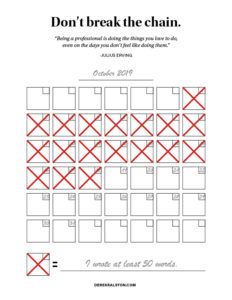
-Jerry Seinfeld

How I use this strategy

I’ve set myself a goal to “Write at least 50 words” each day. This goal is so easy that I’ve completed it even on days when my motivation is low. To measure my progress, I use my Don’t Break the Chain printable (get your free Don’t Break the Chain printable).

I usually exceed my daily goal of 50 words—today I’ve written 431. This doesn’t mean that I’ve upped my goal. Any day that I write at least 50 words is a habit-building win worth celebrating.

Do the things you love, even on days you don’t feel like it. -Julius Erving

Click To Tweet

Key Takeaways

  • You fail to create a habit when relying on motivation and setting the bar too high
  • Set a goal so low that you will take action every day and track your progress
  • Figure out one habit you want to build for yourself
  • Make the habit so small that you’ll do it every day. Think: do 1 push-up, floss 1 tooth, or write 50 words.
  • Write it down
  • Track your habit by printing out a copy of my free Don’t Break the Chain template
    • Write your habit out at the bottom of the template
    • Put a big “X” on each day you complete your habit
    • Your only goal now: Don’t Break the Chain

(photo by SC-Creations)

Share this:

  • Tweet
  • Email a link to a friend (Opens in new window) Email

Self-Knowledge Through Data Nerdery: How to Quantify Yourself

August 10, 2018 by derek Leave a Comment

Self-Knowledge Through Data Nerdery: How to Quantify Yourself

I have a confession to make. I’m a data nerd. For the last eight months, every night, I’ve kept a sort of data-driven diary, with inputs from my daily life tracked inside a spreadsheet. And I’m not alone. There’s the Quantified Self Movement, where data nerds attend meet-up groups to talk about their own self-tracking methods. The movement’s cofounder Gary Wolf explains it as “self-knowledge through self-tracking with technology.” I haven’t yet attended any of these meet-ups, but I’m sure there are people that get even nerdier with their data than I do.

Why go to all the work of tracking data on yourself?

It’s not for everyone. You need enough self-discipline to spend 5-10 minutes on data entry each evening, consistently, for a few months at minimum. But the rewards are huge once you have accumulated enough data to pull some insights. Think about studies you read in the news, such as “drinking 2-5 cups of coffee a day results in x health benefits.” I don’t care about these studies too much, if I can’t take action on their insights in my own life, and test the results. By tracking your own data, you’ll uncover real insights, such as “When I drink 2-3 cups of coffee a day, I have an improved mood + am a more productive writer/exerciser/whatever. But when I have no coffee, or I have more than 3 cups of coffee, I don’t see these benefits. So 2-3 cups of coffee is my personal sweet spot.”

Find your personal sweet spots

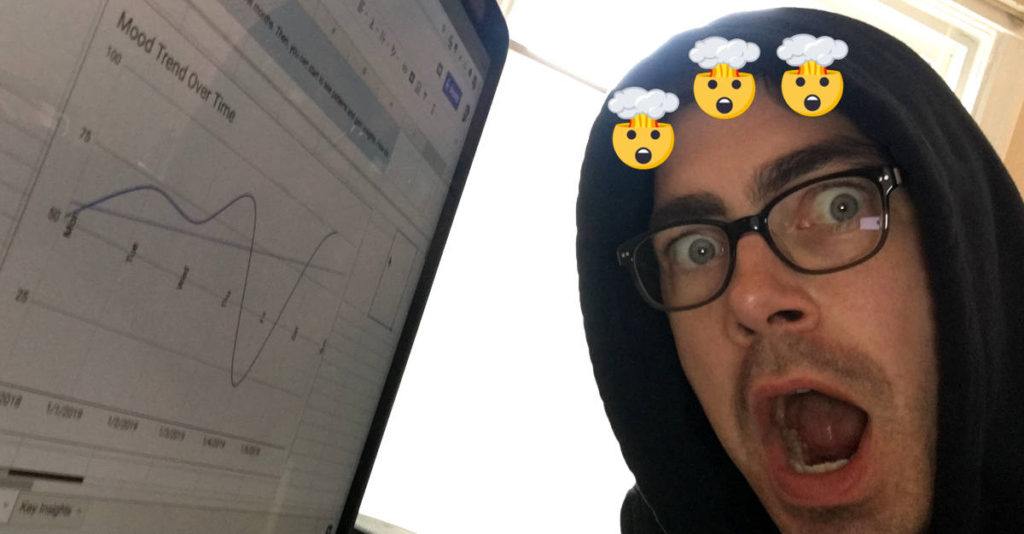
Tracking mood trends over time can help you gain valuable insights into your personal

Tracking mood trends over time can help you gain valuable insights into your personal sweet spots around things like social time vs. me time that you might not otherwise recognize.

I’ve been getting better at it, but I haven’t always been the best at listening to myself, and my needs, on an emotional level. Tracking this data has help me stay connected to + listen to myself. For example, I haven’t always realized how how much / little “me time” I need. By tracking social activities, I’ve been able to find the “sweet spot” for social activities, while paying more attention to this in my day-to-day, knowing that my “sweet spot” for social time is likely to change over time and other things going on in my life.

Stay accountable to your goals + see if they are delivering the results you seek

I have a goal of getting 90 minutes of cardio in each week. By tracking my cardio minutes, I can see if I’m on/off track. I can also dig into the “why” behind the goal, for example, does getting more or less cardio impact my average mood score for the week?

As another example, when I was recovering from a back injury, I tracked my injury pain, daily physical therapy exercises, and any other physical activity I did during the day. This helped me track progress to my recovery (and showed me when I pushed toward recovery too aggressively).

Why use a spreadsheet? Isn’t there an app for that?

Yes, but quantified self apps are at the very early stages of providing useful insights on your data, and don’t allow you to customize the data you want to track. I haven’t seen any apps out there yet that allow for creative minds / spreadsheet nerds like myself to dig deeper into the data. The apps that help you quantify yourself right now (ex. Gyroscope) do this by pulling in data from all your other apps (e.g. Health Tracker, Fitbit, RescueTime), adding in their own features (ex. Mood Tracking), and spitting out daily + weekly insight reports. If you’re like me, you pay attention to these reports a few times and then get bored as they lack actionable insights. You want to dig into the data your own way.

How to track your data: try my spreadsheet template

I’ve created a Google Sheet template that you can copy to your personal Google Drive (or save offline), get your Free Habit Tracking Spreadsheet.

To keep your tracking consistent, try connecting the habit of recording this data to one of your daily habits. For example, maybe you record it before you brush your teeth and go to bed. When you remind yourself “It’s time to brush my teeth”, you can also say “Oh and record my data”, so you don’t forget.

Ideas of things data to track

Here’s some of the data I track each day:

Data Fields

  • Mood Score: There are plenty of apps out there that generate this, or you could create your own scale. I use Gyroscope Pro which gives me a 1-minute swipe-left/swipe-right survey, ending in a mood score of 0-100.
  • Hours of Sleep: The hours of sleep I get each day. I was gathering this data using my Fitbit sleep tracker, but got tired of wearing it, so now I estimate it based on time to bed and wake-up time.
  • Meditation Minutes: How much time I sit in meditation each day
  • Strength Training Minutes: How much time I spend on strength training that day
  • Cardio Training Minutes: How much time I spend in my ideal cardio zone each day. I use a Polar chest strap that tracks my heart rate during cardio and feeds that data to an iPhone app.
  • Caffeine: How many cups of coffee/tea I have each day. I adjust the number of cups depending on volume and caffeine content (coffee is usually 2-4x the caffeine content of tea)
  • Alcohol: Number of drinks I have in the day, adjusting for strength. So 1 12-oz beer would be equivalent to 1 1.5 oz shot of whiskey or a 4-5 oz glass of wine.
  • Social Activities: Anything that’s above the normal social interactions for me. If I met a friend or had a date after work, this would count as one social interaction.
  • Fast Hours: If I fasted during the day, how many hours I spent in the fasted state. Read my blog post about doing a 3-day fast.
  • Injury Pain: If I am recovering from any sort of injury, I track the pain level here, so I can see if my recovery strategy is working (and show it to my chiropractor / physical therapist)
  • Pomodoros: I usually track my writing + editing in pomodoros (25-minute increments). Read my blog post about using the Pomodoro technique.

Text Fields

  • Supplement Changes: If I started/stopped taking any supplements, those would be noted here, especially ones that could have an impact on my energy levels or circadian rhythm (ex. melatonin, rhodiola, etc).
  • Sleep Insights: Any details about the quality of my sleep, interesting dreams I had, and how many times I awoke during the previous night
  • Interesting Insights: Overall impression + description of my activities for the day, usually in 2-3 paragraphs

How to turn the data into actionable insights

The data you’re tracking isn’t very interesting until you’ve accumulated it over the course of several months. Then, you can start to see patterns and gain insights. How do you go about gaining those insights?

Use graphs to look for trends over time

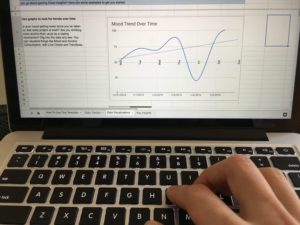
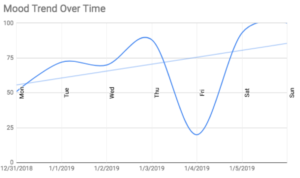
Is your mood getting lower since you’ve taken on that extra project at work? Are you drinking more alcohol than usual as a coping mechanism? Dig into the data and see. You can visualize Mood and Alcohol Consumption with Line Charts and Trendlines.

Use graphs to look for trends over time

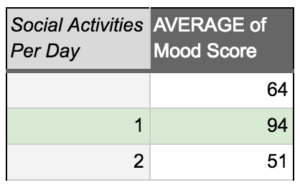
Use pivot tables to correlate your mood to other data points

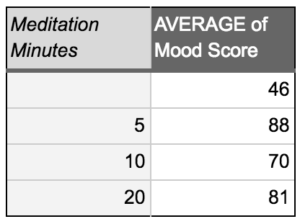
Are you happiest on Sundays? Is your mood higher on days that you meditate for 20 minutes, or 60 minutes? 2 cups of joe, or 4? Are you happier on days that you have social things going on?

Use pivot tables to correlate your mood to other data points

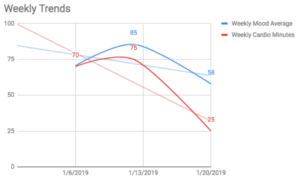
Uplevel your data: Track weekly trends over time

Daily data is important to track, but there’s a high signal-to-noise ratio when you go to visualize it and search for trends. That’s why it’s also important to look at weekly trends in things like Mood and Cardio Minutes.

Uplevel your data: Track weekly trends over time

Identify your personal “sweet spots”

Is your mood highest when you have a social activity planned? That’s useful to know so you can plan your weeks out in a balanced way. These “sweet spots” are important to look at for both daily and weekly trends (ex. maybe 3 social activities per week is your sweet spot).

Identify your personal “sweet spots”

Track all of your Key Insights

After digging deep into the data, and finding some meaningful insights, it’s time to make them actionable. Put them into a separate sheet, and write out the TL;DR + details of the insight. Then, it’s up to you to test out this insight, with an open mind, knowing that your hypothesis could be wrong.

One example for me would be melatonin: I was taking it to get to sleep, but also noticed in my sleep notes that on the nights I took it, I had snoring issues and awoke more often in middle of the night. And I realized that I didn’t really need it as the body naturally produces this stuff. So I stopped taking it.

Don’t use the data to beat yourself up

The data is there to help you. For example, a low mood score isn’t a bad thing. It’s just a signal. Maybe that signal means that you need some more self-love or balance in your life. Maybe you need less “doing” and more “being” in your life. Or there could be something from your past that you need to let go of, like an old story you’ve told yourself many times that is now holding you back. Or maybe you are suffering in some way, but not listening to yourself and letting the emotions bubble up so that the energy can be resolved. Sitting in meditation and focusing on your breath can help when you notice this.

Own it: Make the spreadsheet yours

The Google Sheet template I created (get your Free Habit Tracking Spreadsheet) is just a template. It’s not your spreadsheet until you customize it to your unique needs. To make it yours, try journaling about what you’re most curious about in your own life:

  • “Does that physical therapy that the doctor prescribed really help me recover from my injury?”
  • “Am I happier when I meditate?”
  • “How is my sleep impacted when I have more than a few drinks?”

Just staying curious and journaling about this stuff will help you figure out what data is worth tracking. So start small, keep it up, and after a few months, dig into the data. It’s fun. A bit addictive. And mysterious… Who knows what insights you’ll uncover about yourself (=

Share this:

  • Tweet
  • Email a link to a friend (Opens in new window) Email

How Walking 500 Miles Across Spain Changed Me (A Year Later)

August 4, 2018 by derek Leave a Comment

How Walking 500 Miles Across Spain Changed Me (A Year Later)

This is your life. You wake up early, pack your sleeping bag away, put on your backpack, and walk. Yellow arrows tell you which direction to go. Scenic farmland. Small village. Industrial wasteland. Large city. You arrive at your next hostel. Rinse and repeat. Each day, the seasons change just a little. Grapes vines begin blossoming. Before you know it, you’ve arrived.

It’s a simple way of life. And when you complete your camino, you feel a little empty. That identity that you spent your whole life building, that shell you’ve built around yourself for protection from pain, has a crack in it. Or if you’re lucky, it’s broken. After you return, you’re not the same.

I lived this simple life for six weeks in Northern Spain, beginning at the French border and ending on the Atlantic coast (see my daily travel log). Each day, I connected with pilgrims, ate delicious food, and contemplated life.

Why I walked

If you’re open to it, a pilgrimage is one path to let go of the parts of your identify no longer serving you and be reborn into something new. I went into my pilgrimage seeking answers. My relationship and job had hit their expiration dates, and I needed a kind of bridge. I didn’t think of the journey as spiritual, I just needed time to reflect and figure out the next steps on my path.

What I learned

To let go

I contemplated that all the things in my life that I’d been attaching myself to had expiration dates. To enjoy these fully, but then allow myself to relax and let go. I had spent so much of my life building an identity, attaching myself to something, in order to avoid pain. Maybe it would be easier if I changed my relationship with pain, instead of trying to avoid it.

To appreciate

Everyone that comes into my life is there for a reason. To not take them for granted. Every pilgrim I met along my journey taught me something, was there for me at the moment when I needed it.

To listen

To my body. To my heart. To stop seeking outer solutions to inner problems and move toward a path of self-love. To use meditation to stay centered and connect with my higher self.

To dig deep

To contemplate my deepest values and ideals. To seek work that fills me versus empties me. To find meaningful work that fills my bucket.

A year later

When I returned, my pilgrimage hadn’t ended. I didn’t come back with all the answers I was looking for. But something had shifted. My heart had opened. I felt a sense of connection and spirituality. My shell had a crack. Fast forward to a year later, and a part of me has been trying to patch the shell up, but unsuccessfully. And that’s spiritual growth.

Recommended Readings

On pilgrimaging, letting go, and finding your heart:

  • Rebirth– Kamal Ravikant’s inspiring novel based on walking the Camino de Santiago.
  • The Surrender Experiment– Michael A. Singer’s true-life story on what happens when you just let go.
  • Soulshaping– Jeff Brown’s inspiring memoir on struggling to find his heart and a more authentic, soulful path.

Share this:

  • Tweet
  • Email a link to a friend (Opens in new window) Email

I Spent My Birthday Doing a 3-Day Transformational Fast, Here’s What Happened

July 28, 2018 by derek 2 Comments

I Spent My Birthday Doing a 3-Day Transformational Fast, Here’s What Happened

2022 Update: Since writing this blog post about my first transformational fasting experience, I’ve learned a lot more through research and experiences, and was inspired to write a book on the subject. Get your free sample chapters of my latest book  at Transformational Fasting: Reconnect with Yourself, Get Health, and Find Your Purpose or read an except from it here.

It was a week before my birthday. How to celebrate? Take a road trip up north to do some hiking + exploring in Oregon? Down south to enjoy the beach in San Diego? Or I could stay put, go on an “inner road trip”, disconnecting from everything. This third option felt right to me. I’d spend 3 days fasting from food + other nourishing things in my life: friends, family, technology.

Why would any sane person choose to spend their birthday weekend depriving themselves of good food, quality time with friends and family, and quality time with their precious iPhone? I’m not sure, but maybe the question is wrong in assuming I’m a sane person… After all, I’m the same guy that walked 500 miles across Spain a year ago.

24-hour fasts were familiar to me, and I really enjoyed the focused energy those gave me (and the appreciation for food I had post-fast). I’d also learned about the health benefits of fasting (longevity, ketosis + fat burning, healing, reduced inflammation, immune system reset, autophagy + cancer cell recycling, diabetes prevention).

What the eyes are for the outer world, fasts are for the inner. -Ganhdi

Click To Tweet

As I dug deeper, I realized that fasts are multi-faceted things… They have a physical dimension, for sure, but also an emotional and spiritual dimension. As I was feeling a bit spiritually depleted, I wanted to use fasting to reconnect with myself and my purpose on a deep level. And I also saw how my emotional and physical dimensions could benefit from fasting. I decided that this wouldn’t be a modern “physical cleanse” fast. This would be a transformational fast, which is historically, in alignment with why people have fasted. What better time to do this deep inner work than during one’s birthday?

Doing Your Homework

As with most things in life, it helps to do your homework. I got a lot out of the following books:

  1. For understanding the science behind fasting + any practical concerns: The Complete Guide To Fasting by Jason Fung and Jimmy Moore
  2. For understanding the “how” and “why” behind a spiritual fast: The Transformational Power of Fasting by Stephen Harrod Buhner
  3. For pure motivation during your fast (a long read, an oldie but goodie, a bit lax on science and strange recommendations such as peeing into a cup each day of the fast and then checking your pee a few days later to see what was cleaned out): The Miracle of Fasting by Dr. Patricia Bragg and Dr. Paul C. Bragg

I started by thinking about the “why” behind my fast through the lense of spiritual, emotional, and physical dimensions, and set myself goals along those lines. My spiritual goals were around clarity of my life’s purpose and how to live a more spiritual life. My emotional goals were around listening to my body and reflecting on how I deal with discomfort. My physical goals were around wanting my body to feel healthier and healed in areas that I had injured previously.

I decided to fast from Thursday evening after dinner until Sunday (my birthday) dinner. Most of the fast would be spent at home in a peaceful, low-stress environment. I’d take a walk in nature if/when I had the energy. There would be no rigorous exercise, as I wanted to conserve my muscle while my body was adapting to fat-burning mode (ketosis). I’d be disconnected from family, friends, and technology during the fast with two exceptions: 1) I’d be working from home on Friday, 2) I’d text my family once per day to let them know I was alright. Also, while I didn’t allow myself to watch movies or TV shows, I allowed myself to read + research during the fast.

As much as possible, I’d fast mindfully, letting the fast take me where it wanted to go. I’d use a journal to check-in every few hours with my spirit, emotions, and body. I’d show non-judgement and acceptance to the parts of myself in discomfort. I’d sit with my emotions, and as they came up, I’d reflect on the first time I had felt that way.

Throughout the fast, I’d keep track of changes to my blood ketosis level and body weight. Ketosis (when your body starts using fat as its primary energy source) would be important in order for me to determine if I achieved therapeutic ketosis for cancer prevention (see a full explanation of ketosis levels and therapeutic ketosis here). I’d use the Keto-Mojo to track my blood ketones (those pee sticks aren’t very accurate). While I’d be on a water fast, I’d allow myself other non-caloric beverages like coffee and tea. To ensure I had proper electrolytes (and prevent cramping while walking in the forest), I’d occasionally sprinkle himalayan salt into my water. I’d go in knowing that less sleep is OK and normal during a fast, and also track my dreams in my journal.

Coming out of the fast, I would reintegrate slowly, with a small meal first. I would also share the parts of the journey I felt comfortable sharing with someone close to me (and here!).

What happened: my body

I started with blood ketones of .8, which is on the low end. I ended with blood ketones of 4.7, which is in the therapeutic zone. My weight dropped 7 pounds. A week later, I had gained back 5 pounds, so most of the weight loss was water weight (and I suspect the other 2 pounds were fat I burned from going into ketosis). This worked out for me as I’m only 11% bodyfat and my goal isn’t to lose more weight. Hunger pangs came and went through the fast, though by day 3, they seemed to be less intense (per research, day 2 of a fast is usually the worst for hunger).

My body was cold and became progressively colder through the fast. My tongue was covered with a white film and my teeth felt sticky (nothing that a toothbrush and tongue scraper couldn’t fix). My breath likely smelled bad but luckily I was alone. Physical and mental energy came in spurts. I spent a lot of time reading and journaling (and urinating, due to all the water I took in!). I did some short walks through the park and the nearby forest, but didn’t feel the energy to do anything longer. Sleep was sporadic, and worst at the 24-36 hour mark. I took several long naps the next day which helped me feel energized.

As the fast progressed, my senses became progressively stronger, and my body felt progressively lighter. I wonder how this would’ve felt had I decided to do a 7-day fast instead of a 3-day. Healing took place in several previously-injured parts of my body.

Following up a few weeks later, I am still down several pounds from the start of my fast. One interesting thing I noticed is that my body seems more fat-adapted now, meaning it switches over to fat-burning mode faster than before. As an example, when I hit the 24-hour mark for ketosis during my 3-day fast, I was at 1.7 blood ketones. But when I tried a simple 24-hour fast a few weeks later, at the 24-hour mark, my blood ketones were already at 2.4. Will continue to monitor this.

What happened: my emotions

All the advice stays to “stay busy” during a fast. This was easy enough on the first day, since I was working from home. Days 2 and 3, I didn’t have the energy to do much, and what’s the point of “staying busy” if your goal is spiritual growth? I wanted to fast mindfully, and let the fast take me where it wanted to go.

While I tried fasting mindfully, my mind had strategies of its own for dealing with the boredom and discomfort. One was to fantasize about all the stuff I was missing out on, such as beer, pizza, and Netflix… I even craved healthier stuff like a tuna avocado sandwich. When it wasn’t fantasizing, my mind resorted to outright questioning me: “Can you really do this for 2 more days?!”

What happened: my spirit

The deeper I went into the fast, the more spiritually connected I felt (and my body felt lighter at the same time). I gained clarity around what living a spiritual life means to me, and how I can shift priorities on my life to work towards that. And the fast allowed me to work on my relationship with discomfort, adopting one with more self-acceptance and letting go vs trying to control things or distract myself.

Meditation, walking in the forest, journaling, and soaking in the bath were all helpful in staying mindful. Trying to control the fast became a metaphor for how I try to control other parts of my life. It was good that I went in with specific goals for the fast, but I later learned I had to let go of any preconceived notions around what I’d be experiencing, and let the fast take me where it wanted to go.

Fast Retrospective

Going on my first 3-day fast has been life-changing for my overall wellbeing. I feel a deeper connection to my body, emotions, and spirit. I listen to my body and emotions more, tuning in to how I’m feeling, versus tuning out by distracting myself. At work, I’m more mindful of when I make myself feel overwhelmed on busy days. I’ve re-prioritized my daily work and personal activities so that they are better aligned with living a spiritual life. The biggest lesson I learned around fasting? Let the fast take you where it wants to go. Don’t try to control it.

Share this:

  • Tweet
  • Email a link to a friend (Opens in new window) Email
  • « Previous Page
  • 1
  • 2
  • 3
  • Next Page »

Don't Miss Out

Get my latest personal growth tips and bonus material.

Success! Now check your email to confirm your subscription.

There was an error submitting your subscription. Please try again.

Powered by Kit

Copyright © Derek Ralston, 2016-2046 | Design by Carla Gabriel Garcia